
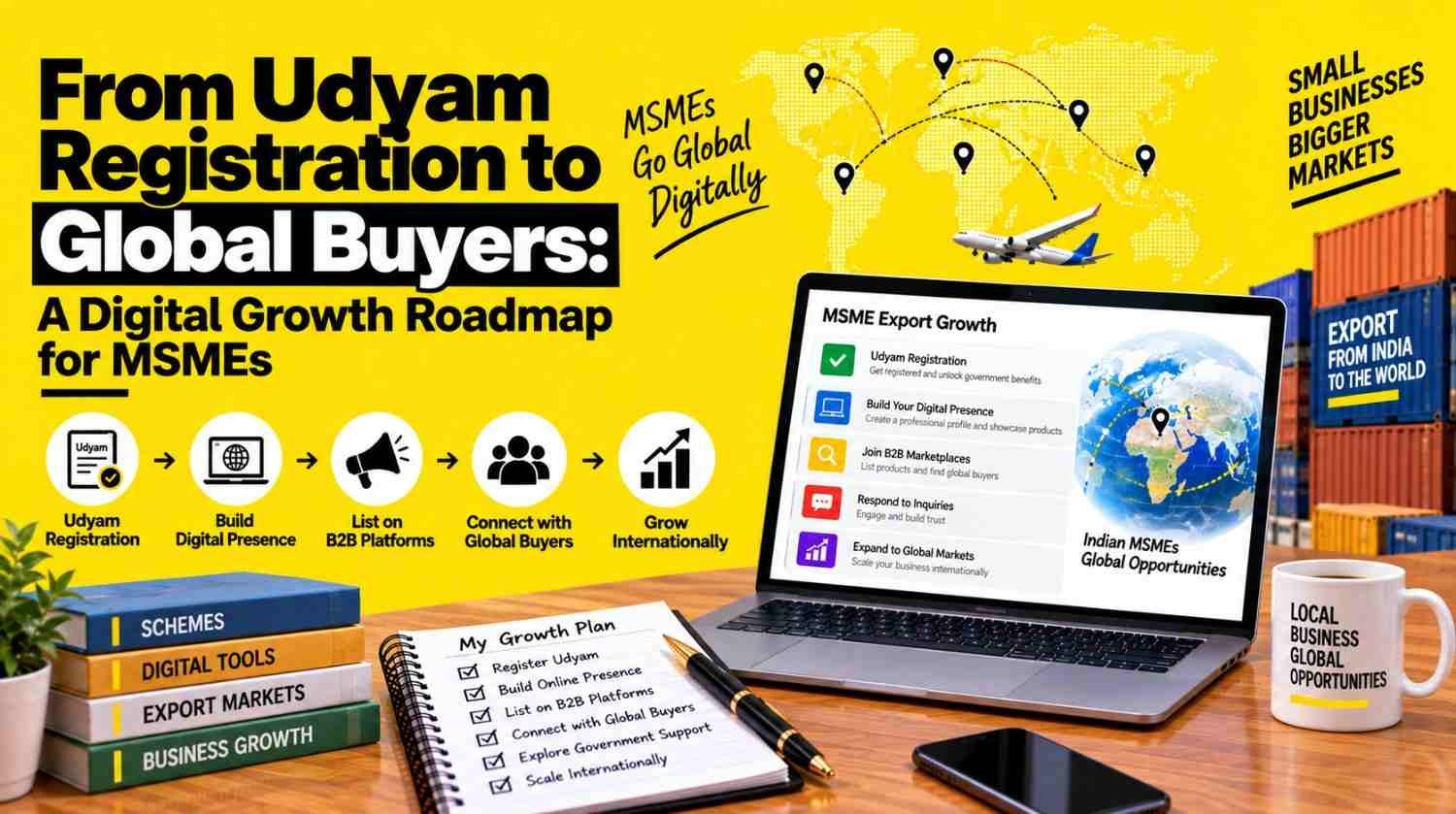
A step-by-step roadmap connecting MSME formalization, business credibility, product catalogues, online visibility, RFQs and international buyer acquisition.
Stage 1: Formalize the Business
Complete registrations that actually apply to your enterprise. For eligible Indian MSMEs, use the official Udyam channel and verify current requirements directly from government sources.
Stage 2: Make the Offer Buyer-Ready
Define products, specifications, pricing logic, MOQ, production capacity, packaging and lead times. A buyer cannot evaluate an unclear offer.
Stage 3: Build Credibility
Organize company information, real product photographs, relevant certifications and professional communication. Keep every claim accurate and current.
Stage 4: Build Digital Visibility
Create useful product pages and supplier profiles using the terms real buyers search. Combine your own digital assets with suitable B2B discovery channels.
Stage 5: Respond to Buyer Requirements
Develop a standard quotation workflow for inquiries and RFQs. Capture specifications, quantities, destination, payment terms and timelines before final pricing.
Stage 6: Prepare for International Business
Research target markets, product compliance, documentation, freight, payment risk and landed economics before accepting export orders.
Stage 7: Use TradesFolks as a Growth Channel
TradesFolks can be part of the visibility and sourcing mix through supplier profiles, product discovery and RFQ-led interactions. Use any currently free features to test demand without unnecessary upfront marketplace cost, while checking current terms.
Conclusion
MSME growth is a sequence rather than a single registration or marketplace listing. Formalize, improve the offer, build credibility, increase discovery and measure which channels generate profitable repeat business.
Practical Checklist
- Define the exact buyer, supplier or market you are targeting before spending on promotion.
- Keep company details, product specifications, MOQ, lead time and commercial terms consistent across channels.
- Verify counterparties, certifications and transaction-specific requirements before payment or shipment.
- Track qualified inquiries, quotations, conversions and repeat orders instead of measuring visibility alone.
- Review regulations, scheme rules and platform pricing from current official sources whenever they can change.
How to Measure Results
For B2B growth, useful metrics include qualified inquiries, response time, quotation rate, order conversion, average order value, repeat business and customer-acquisition cost. A channel with fewer but more relevant inquiries may be more valuable than one generating a large volume of low-fit contacts.
Frequently Asked Questions
Is online visibility enough to generate B2B orders?
No. Visibility helps discovery, but buyers still evaluate product fit, price, capacity, documentation, communication, delivery capability and commercial risk before placing an order.
Should a business depend on one marketplace?
Usually it is safer to combine multiple channels such as a company website, direct outreach, referrals, exhibitions, buyer-seller meetings and suitable B2B platforms. The right mix depends on the product and target market.
Related topic: MSME business growth should be evaluated in the context of the business, target market and current commercial requirements.