
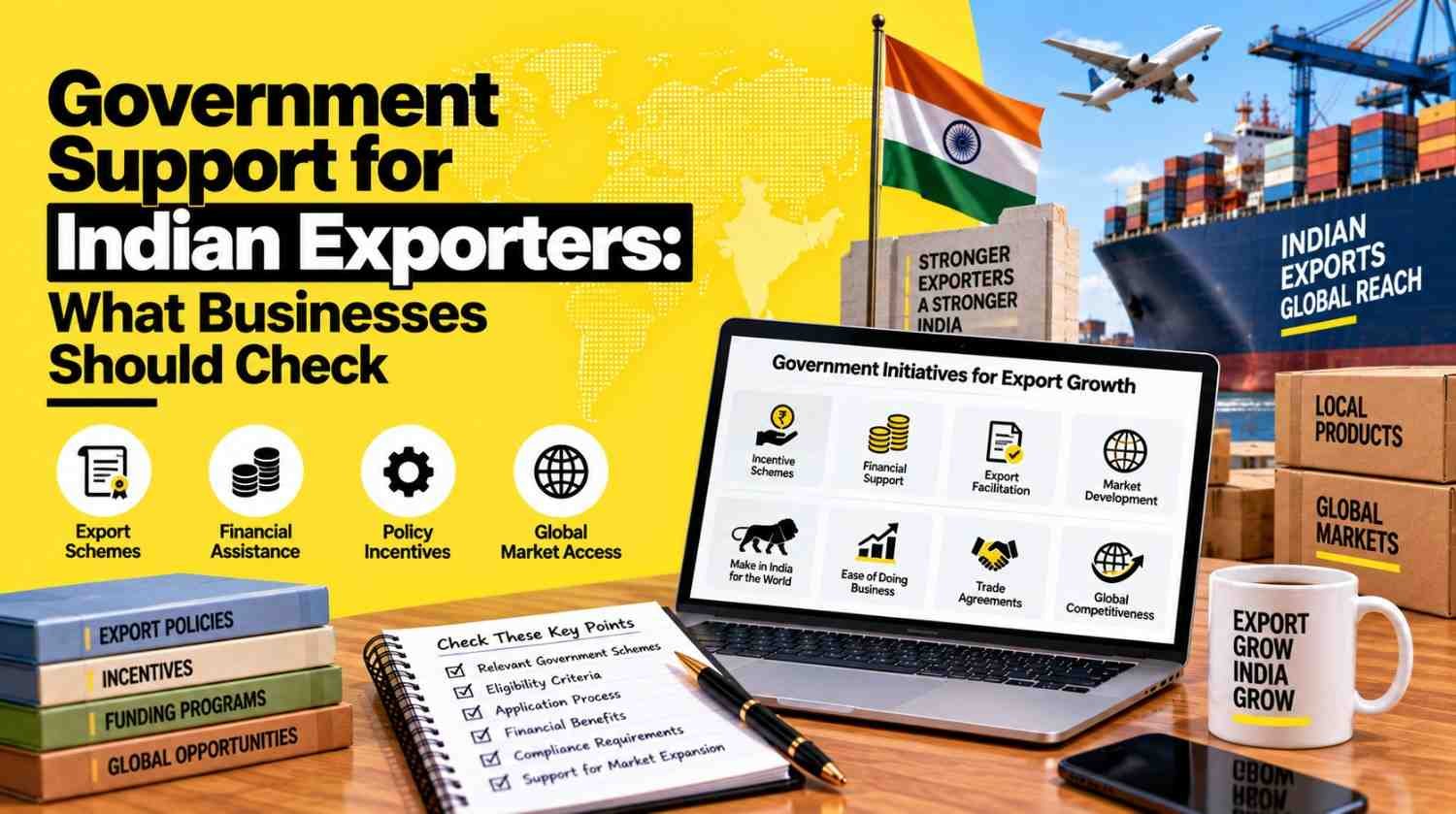
Understand the main types of government support Indian exporters may encounter and how to verify current scheme benefits, eligibility and documentation.
Start With Official Sources
Export policies and scheme rates can change. Use current DGFT, customs, relevant ministry and export-promotion sources before making pricing or compliance decisions.
Remission and Duty-Related Support
India has used mechanisms such as RoDTEP to remit certain embedded duties and taxes subject to applicable rules, products and rates. Exporters should verify the current schedule and eligibility for their tariff lines.
Export Promotion Resources
Sector-specific export promotion councils and government trade resources may provide market information, events, guidance or other support. Relevance depends on the product and destination market.
Finance, Insurance and Risk
Exporters may also encounter institutional support related to credit, guarantees or insurance. Commercial suitability depends on the transaction and current program terms.
Documentation Still Matters
Government support does not replace correct classification, invoices, shipping documents, certificates, customs processes or destination-country compliance.
Convert Export Readiness Into Buyer Discovery
After improving export readiness, businesses still need demand. Product catalogues, supplier profiles, direct outreach and B2B marketplaces such as TradesFolks can help create additional discovery opportunities.
Conclusion
Do not build an export quotation around an assumed incentive. Verify current official rules first, then combine applicable support with disciplined costing and buyer acquisition.
Practical Checklist
- Define the exact buyer, supplier or market you are targeting before spending on promotion.
- Keep company details, product specifications, MOQ, lead time and commercial terms consistent across channels.
- Verify counterparties, certifications and transaction-specific requirements before payment or shipment.
- Track qualified inquiries, quotations, conversions and repeat orders instead of measuring visibility alone.
- Review regulations, scheme rules and platform pricing from current official sources whenever they can change.
How to Measure Results
For B2B growth, useful metrics include qualified inquiries, response time, quotation rate, order conversion, average order value, repeat business and customer-acquisition cost. A channel with fewer but more relevant inquiries may be more valuable than one generating a large volume of low-fit contacts.
Frequently Asked Questions
Is online visibility enough to generate B2B orders?
No. Visibility helps discovery, but buyers still evaluate product fit, price, capacity, documentation, communication, delivery capability and commercial risk before placing an order.
Should a business depend on one marketplace?
Usually it is safer to combine multiple channels such as a company website, direct outreach, referrals, exhibitions, buyer-seller meetings and suitable B2B platforms. The right mix depends on the product and target market.
Export Readiness Checklist
- Confirm the product classification and destination-country requirements.
- Calculate landed or delivered economics using realistic freight, insurance, duties and handling assumptions.
- Prepare accurate product specifications, packing details, quotation terms and required trade documents.
- Agree Incoterms, payment terms, inspection expectations and responsibility for logistics in writing.
- Verify the buyer and use transaction-appropriate risk controls before dispatch.
Turning Visibility Into Export Business
Export visibility should lead to a disciplined qualification process. Ask about destination, quantity, specification, required certification, delivery schedule and preferred trade terms before issuing a final quotation. This reduces avoidable revisions and helps both sides determine whether the opportunity is commercially workable.
Related topic: government schemes for exporters should be evaluated in the context of the business, target market and current commercial requirements.